Guys 40+ / Book 3
Ending the
Friendship Famine
A practical guide to building friendships that actually matter
You didn't decide to let your friendships go. They just went. Gradually, without announcement — the jobs changed, the cities changed, the kids arrived, the weekends filled up. And at some point you looked up and the friends were gone.
That's not a personal failure. It's what happens to men structurally in their 40s and beyond. The structures that used to create friendships — shared institutions, proximity, time you didn't have to manufacture — disappeared. Nobody replaced them.
No forced socializing. No advice to "just put yourself out there."
Does this sound familiar
"I have colleagues, I have acquaintances. But a real friend? I can't actually name one."
The isolation problem"I know I should reach out. I just never do. I'm not sure why."
The avoidance loop"Every guy I know seems fine. I can't tell if I'm the only one who feels this way."
The visibility gap"We used to be close. Now we just trade texts once a year."
Dormant friendshipsResearchers at the University of Kansas found that close friendships require roughly 200 hours of shared time to form. Most men 40 and beyond don't have 200 unscheduled hours anywhere — and no one is telling them how to build that time back into their lives.
This book does exactly that.
What the book covers
The structural collapse of male friendship — and how to rebuild it.
Why it's not your fault — and why that matters
Male friendship collapses at predictable life stages. The mechanisms are documented and structural — not personal. Understanding why it happened the way it did changes your relationship to the isolation itself, and removes the self-blame that makes reaching out feel impossible.
The 200-hour threshold
University of Kansas researcher Jeffrey Hall identified the contact hours required for different levels of friendship. Close friendship takes roughly 200 hours. That number doesn't lie — but it does give you something specific to work with instead of vague advice about "putting yourself out there."
Dormant friendships — how to re-enter them
Most men 40 and beyond have dormant friendships — connections that were once close and then quietly went cold. These are often easier to rebuild than starting from scratch. This chapter gives you the exact re-entry script and removes the awkwardness from the first move.
Making new friends after 40
Most advice on making friends sounds fine in theory and catastrophically awkward in practice. This chapter covers the specific conditions in which adult male friendships actually form — shared activity, repeated unplanned contact, the right context — and how to engineer those conditions without it feeling engineered.
The social discomfort barrier
For many men, the obstacle isn't logistics — it's the discomfort of reaching out, of being the one to initiate, of vulnerability that isn't tied to a practical purpose. EFT protocols specific to social avoidance address this directly, at the nervous system level.
Maintaining friendships as an adult
Adult friendships require deliberate maintenance in a way that younger friendships didn't. This chapter gives you a sustainable rhythm — low effort, high contact — that keeps connections alive without requiring you to become someone who enjoys planning.
About the method
The barrier isn't usually logistics. It's the feeling before the reach-out.
Most men know they should reach out. They just don't. That pause — the one where you think about texting someone and then don't — has a physiological component. EFT (Emotional Freedom Technique) is a body-based acupressure protocol that addresses the nervous system directly. Takes just a few minutes. Backed by clinical research. Private.
No group work. No social exposure as the therapy itself.
Over 100 clinical trials. Works on the same principle as exposure therapy — without the discomfort of talking about it.
The protocols in this book are specific to social avoidance — not generic stress reduction.
"The reason you don't reach out isn't laziness and it isn't not caring. It's a nervous system response to anticipated discomfort. That's addressable."
— C.M. Wiley
The loneliness data
of men over 40 say they have no close friends at all. Not few close friends — none. That number is rising every decade.
Survey Center on American Lifeof contact time required to form a close friendship, per University of Kansas research. Most men don't know this number exists.
Jeffrey Hall, Univ. of Kansasof men report feeling lonely often or always. But most believe they're the only one. The visibility gap keeps the isolation in place.
Cigna Loneliness IndexThe famine is real. It's documented. And it has known remedies.
Free resource
The Friendship Audit
Five questions about your current social landscape and what's actually getting in the way. Identifies whether your barrier is structural (no time, no context), psychological (avoidance, discomfort), or relational (dormant ties that could be rebuilt).
- Takes just a few minutes
- Identifies your specific friendship barrier
- Delivered as a PDF — no account required
- No spam. One welcome email, then you control the frequency.
Your audit is downloading now.
The Friendship Audit should appear in your downloads folder momentarily. We'll also send a copy to your email — check your spam folder if you don't see it shortly.
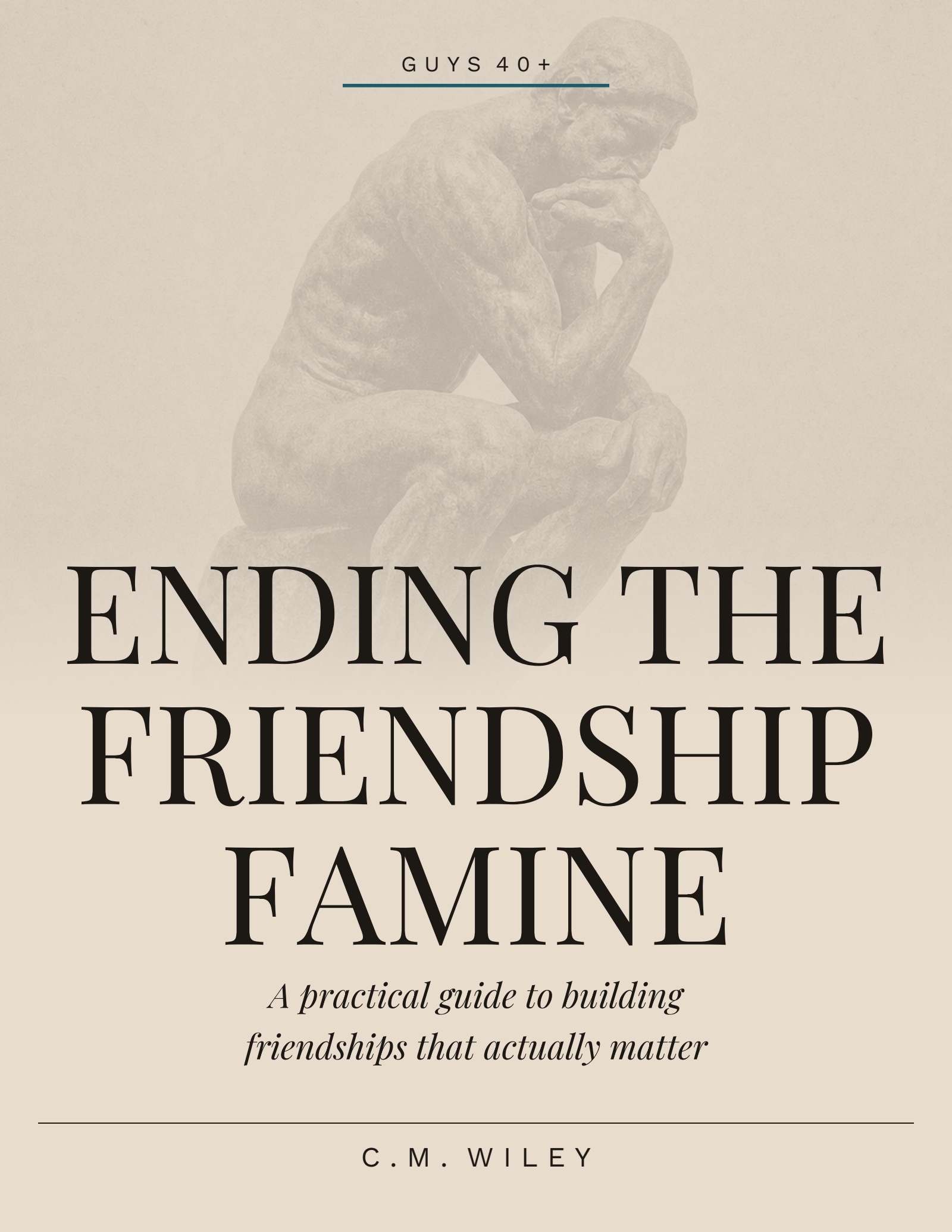
The book
Ending the Friendship Famine
A practical guide to building friendships that actually matter
The research is clear on what male friendship requires to form and sustain. The structures that used to provide it are gone. This book tells you what to do in the actual conditions of your life — not the ones you had at 25, when it happened automatically.
Want all three books? The complete series saves $9.
If it's not useful within 30 days, email for a full refund. No questions.
About the author
C.M. Wiley
I've spent 50 years working alongside men — in IT, defense, medical devices, aerospace, and eCommerce. I've watched the friendships thin out as the careers took over, as the families grew, as the years compressed. And I've watched what happens to men when the social layer is gone and they have nowhere left to put what they're carrying.
I'm a certified coach and EFT practitioner. Ending the Friendship Famine draws on Jeffrey Hall's contact-hours research, sociological data on male loneliness, and practical work with men navigating the second half of their lives.
The friends you had at 25
aren't coming back.
But the friendships you build now — as a 40+ man who actually knows himself — can be the best you've ever had. That's not optimism. That's what the research shows about adult friendship when it's chosen rather than circumstantial.