Guys 40+ / Book 2
Rebuilding Your
Love Relationship
A practical guide for men who want to close the distance
Your partner says you're not present. That you shut down when things get hard. That they can't reach you. And from where you're standing, you're right there — you haven't gone anywhere. You're calm. You're not fighting. You're handling it.
That gap between what they're experiencing and what you're doing is the whole problem. And it has a name.
No couples therapy. No worksheets. No blaming.
Does this sound familiar
"I'm right there and my partner says I'm not present. I don't know what else they want."
The distance problem"The same argument. Different week. Same result."
Conflict loops"I go quiet because I don't want to make it worse. Apparently that makes it worse."
Strategic retreat"I love them. I just don't know how to get back to where we were."
Connection lossThese aren't signs that your relationship is broken or that you're bad at this. They're patterns — defense mechanisms built for situations that probably aren't your current life. They made sense once. They're costing you now.
The wall isn't you. But it is yours to deal with.
What the book covers
The mechanics of distance. And how to close it.
The three wall types
The Intellectualizer converts every emotional conversation into a problem to solve. The Strategic Retreater goes quiet and flat. The Busy Man is never cold — just always elsewhere. You'll recognize yours immediately, and understand why it made sense to build it.
Why "staying calm" can be its own withdrawal
Being the rational one in the room feels like de-escalation. From your partner's side, it can feel like being managed rather than met — left alone in the feeling while you work the logic. This chapter closes that gap in understanding.
Bids for connection — and what missing them costs
Gottman's research on bids for connection: the small reaches toward you that your partner makes constantly, and what accumulates when they go unanswered. Not grand gestures — the quiet ones that add up.
The flooding response
When emotional conversations trigger a physical shutdown — elevated heart rate, narrowed attention, the need to exit. Why your nervous system responds this way during conflict, and how to interrupt the pattern before it closes you down.
Repair that actually works
Not the post-mortem. Not waiting it out until things return to baseline. Not treating normalcy as closure. What real repair looks like and how to initiate it without it feeling like a performance.
EFT protocols for relational stress
Body-based acupressure tools for the specific moments the wall goes up — before conflict escalates, after a disconnecting exchange, when you feel the shutdown coming. Practical. Private. No therapist required.
About the method
If the idea of an emotional technique makes you want to close the tab
EFT — Emotional Freedom Technique — is a body-based acupressure protocol: you tap specific points on your face and upper body while naming what you're feeling. Takes just a few minutes. It works on the nervous system directly — not through insight or conversation.
Used in veteran PTSD programs, not couples retreats.
Over 100 clinical trials. Targets the physiological flooding response directly.
Nothing you have to do in front of your partner. Nothing that requires a joint session.
Specifically applicable to the wall-building patterns this book describes.
"The wall doesn't go up because you decided to build it. It goes up because your nervous system decided for you. That's also where you take it down."
— C.M. Wiley
The numbers behind the distance
of relationship problems are perpetual — meaning they never fully resolve. The goal isn't to solve them. It's to manage them without damage.
Gottman Instituteof people who stonewall during conflict are men. It's not a personality flaw — it's a nervous system response under emotional load.
Gottman Researchthe ratio of positive to negative interactions that predicts relationship stability. Distance erodes that ratio quietly, one missed bid at a time.
Gottman InstituteNone of this is destiny. It's mechanics. And mechanics can be worked with.
Free resource
The Distance Pattern Audit
Five questions about how you respond when emotional proximity gets uncomfortable. Identifies which of the three wall types is your default — and what it looks like from the other side of the room.
- Takes just a few minutes
- Identifies your specific relational defense pattern
- Delivered as a PDF — no account required
- No spam. One welcome email, then you control the frequency.
Your audit is downloading now.
The Distance Pattern Audit should appear in your downloads folder momentarily. We'll also send a copy to your email — check your spam folder if you don't see it shortly.
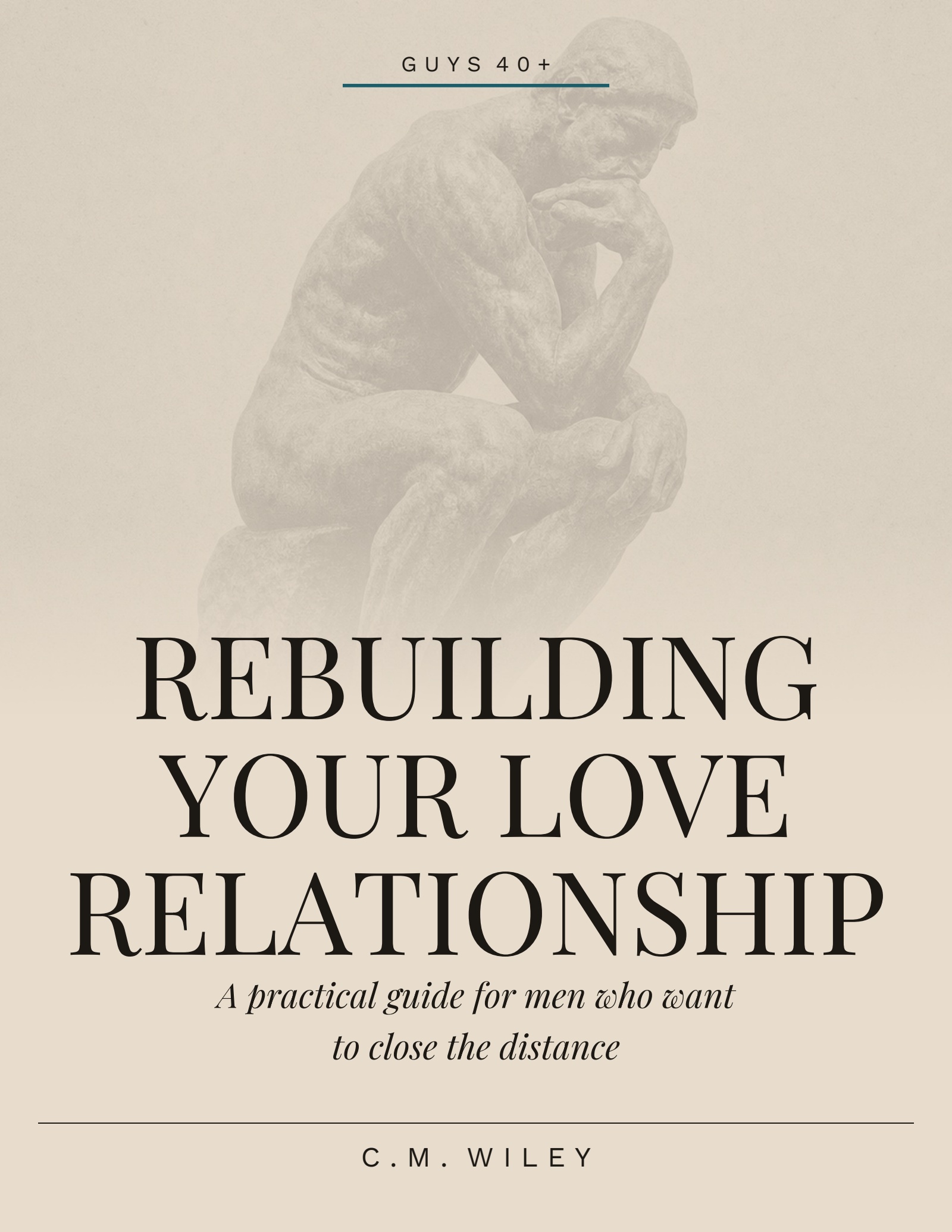
The book
Rebuilding Your Love Relationship
A practical guide for men who want to close the distance
The walls men build in relationships look different from inside and outside. From inside: calm, rational, handling it. From outside: absent, closed, unreachable. This book identifies your specific pattern, explains what drives it, and gives you the tools to close the gap — without a couples therapist in the room.
Want all three books? The complete series saves $9.
If it's not useful within 30 days, email for a full refund. No questions.
About the author
C.M. Wiley
I've spent 50 years working alongside men in male-dominated industries. I've watched what happens when the distance in a relationship becomes the default — and what it costs men, their partners, and their families when no one names it.
I'm a certified coach and EFT practitioner. Rebuilding Your Love Relationship draws on Gottman's research, attachment theory, and decades of watching men navigate — and sometimes wreck — their closest relationships.
The distance didn't build overnight.
But it can start closing today.
Start with the free audit to see your pattern clearly. Or go straight to the book. Either way, you're doing something most men never do — you're actually looking at it.